Concentration Games That Train Focus and Working Memory
By A. Pepper, CEO of Type Click Tests ·
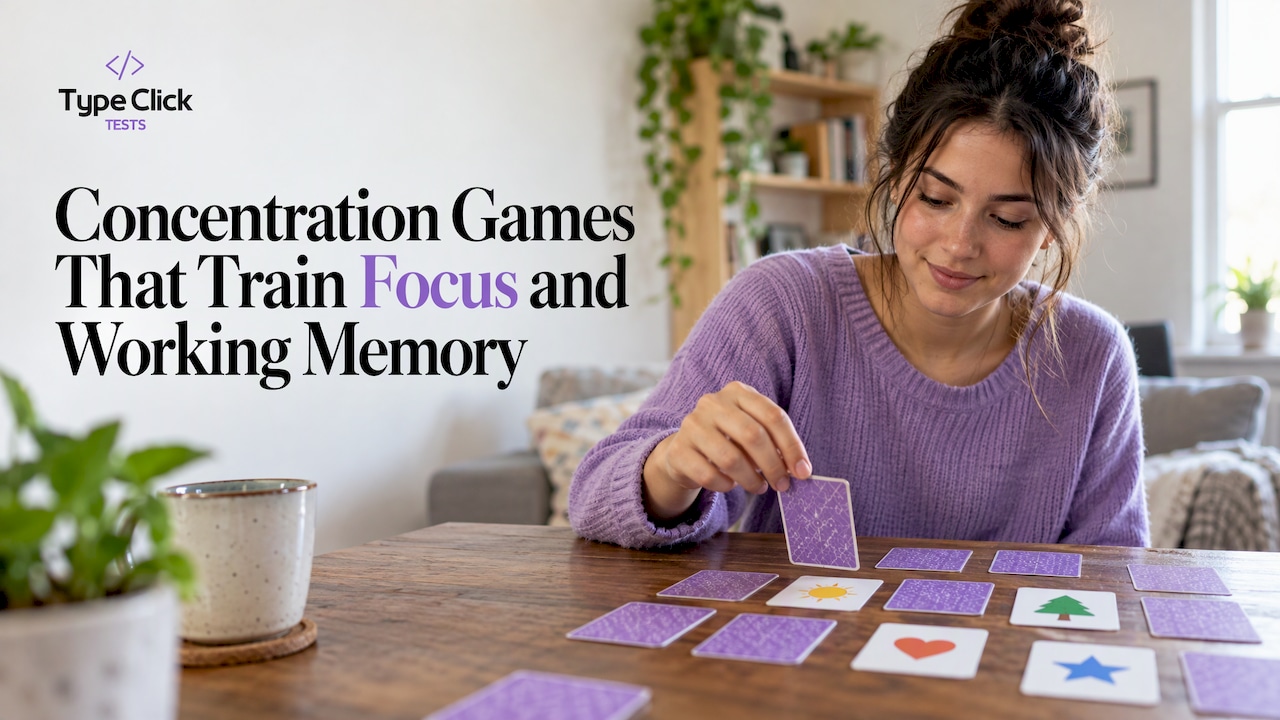
The best concentration games ask your brain to do one specific job under light pressure: hold something in mind, ignore a distraction, or react at the right moment. Card matching, sequence recall, timed typing and quick browser challenges all do this in different ways. Pick one that fits the skill you want, play it in short sessions, and track your score. All of the browser games on Type Click Tests are free and need no signup, so you can start with a round in under a minute.
TL;DR
- Concentration games train different skills: selective attention, sustained attention, working memory and processing speed. Choose the game by the skill.
- The classic card game Concentration (also called Memory) is one of the simplest ways to exercise working memory, because you have to remember where cards are.
- Short, regular sessions beat long ones. A 20-minute daily routine with a single focused game, a single-task sprint and an attention task is a sensible start.
- Timed typing, color memory, timing and reaction games give you a score to beat, which makes progress visible.
- A 2025 meta-analysis of 16 randomized trials found improvements in working memory and processing speed in healthy people, though study designs vary.
Table of Contents
- What counts as a concentration game
- How to play the classic Concentration card game
- Visual memory games
- Games for working memory and short-term memory
- Brain games for focus
- Reaction and timing games for gamers
- Try them in your browser
- A 20-minute daily routine
- What research says about brain games
- FAQ
- Sources
What counts as a concentration game
A concentration game is structured play that asks you to direct and hold your attention. Infusion Health’s guide groups them by the attention system they target: selective attention (filtering out noise), sustained attention (staying on task), working memory (holding information in mind while you use it) and processing speed. Its list includes Stroop-style color and word games, Simon-style sequence games, n-back tasks, number puzzles such as Sudoku, timed typing or reading, and card matching.
Two terms come up constantly, so here they are in plain words:
- Short-term memory is what you hold for a few seconds, like a phone number you are about to dial.
- Working memory is short-term memory that you actively use, like keeping a number in mind while you add another to it.
Harvard’s Center on the Developing Child describes working memory as the ability to hold information in mind and use it, and treats card and board games as practice for these executive-function skills in its 2024 guide. It names matching games such as Concentration for working memory, multi-dimension matching games such as SET for cognitive flexibility, and fast-response games such as Snap for attention and inhibition.
That gives you a simple map for choosing games:
| If you want to practice | Game types that fit |
|---|---|
| Working memory | Card matching, sequence recall, n-back |
| Visual memory | Color matching, spot the difference, Kim’s game |
| Selective attention | Stroop tasks, I Spy, fast-response games |
| Sustained attention | Timed typing, Sudoku, single-task sprints |
| Reaction and timing | Reaction tests, timing games |
How to play the classic Concentration card game
The game most people picture when they search this phrase is the card version, also known as Memory. The rules are simple, per this rules guide:
- Shuffle a standard 52-card deck and lay the cards face down in a grid.
- On your turn, flip two cards.
- If they match (with an ordinary deck, the same rank such as two queens), keep the pair.
- If they do not match, turn them face down again in the same place.
- The player with the most pairs at the end wins.
The skill is remembering positions. When your opponent flips a seven and a king, you quietly file away where they were, because one of them may become your match later.
A few ways to make it a better workout:
- Play solo and count turns. The official Memory rules at UltraBoardGames describe solo play, counting how many turns it takes to match every pair and trying to beat that number, as excellent practice for concentration and memory.
- Start small. Use six or eight pairs, then add more as it gets easy.
- Say the positions in your head. Row and column labels (top left, second row, third from the right) give your memory something to hold.
Harvard’s guide also lists Go Fish, Old Maid and I Doubt It, which add tracking of which cards have been played or asked for. These are good group options when you do not have a screen handy.
Visual memory games
Visual memory is remembering what you have seen: shapes, colors, faces and locations. Several formats train it, and most need nothing but a few objects or a browser:
- Matching games. The Concentration format above, played with picture cards.
- Kim’s game. Look at a handful of objects on a tray for about 30 seconds, look away, then name what was removed.
- Spot the difference. Compare two similar images and find the changes, or study a table of objects, look away and recall what was there.
- Sequence games. Watch a pattern of lights or colors and repeat it, adding one step each round.
- Color recall. Look at a color, then pick or reproduce it from memory.
The last format is where our Color Memory game fits. You guess the color and get an accuracy score, so each round is a small, measurable test of visual recall. If you want to understand how its scoring works, we explain the five-second guess in a dedicated Color Memory guide.
If you are playing visual memory games to study better, our guide on how to improve memory for studying shows how to pair them with study habits. And if you enjoy spotting structure, pattern recognition games are a natural next step.
Games for working memory and short-term memory
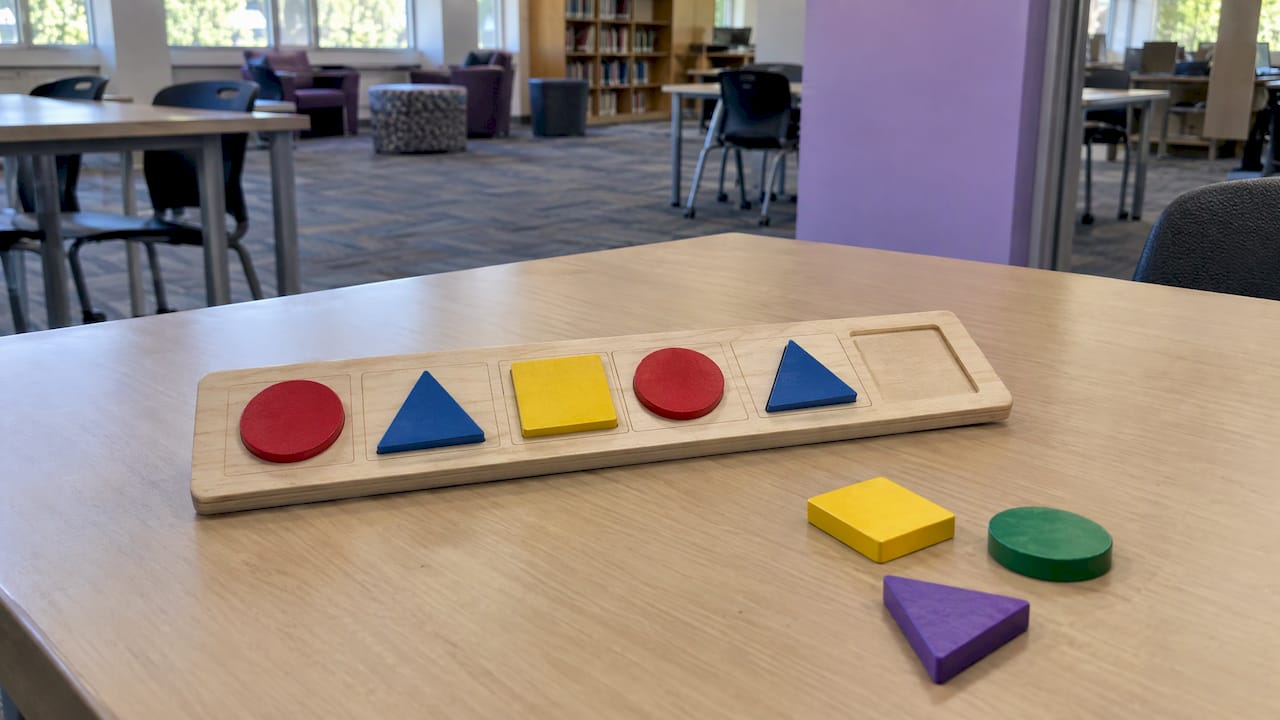
The simplest working-memory exercises are the ones that make you hold something and update it:
- Card n-back. Infusion Health describes a low-tech version: flip through a deck and say match whenever the current card equals the one from one, two or three turns back. Start at one back.
- Read, then recall. Read a paragraph, cover it, and write the key details from memory.
- Simon-style sequences. Repeat longer and longer patterns of lights or sounds, starting with around four items.
- Mental arithmetic. Hold a running total while adding the next number.
- Higher or lower quizzes. You keep a comparison in mind, make a call and keep a streak going. Our Higher or Lower: Countries quiz is built on this loop, and the guide on building a streak covers tactics.
The same guide recommends limiting digital training to 10 to 15 minutes a day to avoid mental fatigue. For students, a University of Oregon handout by Angela Watson suggests 5 to 10 minutes of working-memory games each school day for about nine weeks, rotating a new game each Monday so it stays fresh.
Brain games for focus
Focus is mostly about two abilities: filtering out what does not matter and staying with what does. Games that train them include:
- Stroop tasks. Name the ink color of a word that spells a different color. Two to three minutes per round is plenty.
- Sudoku or KenKen. Number puzzles that demand sustained attention. Choose a level that takes 5 to 15 minutes.
- Timed typing. A five-minute typing session is a real sustained-attention task: you have to keep your eyes on the text, hold the next few words in mind and avoid letting your mind wander. Infusion Health lists timed typing or reading, with wandering-mind checks, among its focus games.
- Zero-material group games. The Berkeley brain games pack includes I Spy, a counting-and-clapping game and a chant-tracking circle game, all playable with no equipment.
Typing is also useful beyond focus. If you are a student or a professional who needs a speed benchmark, a typing test does two jobs at once. Our tests run from 15 seconds to 5 minutes and report WPM (words per minute), CPM (characters per minute) and accuracy, with feedback calculated instantly in your browser. The 3 Minute Typing Test is a good endurance check, because holding accuracy over three minutes takes sustained attention, not just fast fingers. We give accuracy equal weight to speed in our feedback, since rushing and making errors is a focus problem, not only a speed problem.
Reaction and timing games for gamers
If you came here as a gamer, your version of concentration is reaction time and timing: waiting for the right instant and acting on it without flinching early.
- The F1 Reaction Test has you respond to a lights-out start.
- Stop the Wheel is a timing challenge with 30 levels where one miss sends you back to the start, so it rewards calm, steady attention. The level-by-level guide explains how the levels progress.
- The 5 Second Click Test and 30 Second Click Test measure clicks per second over a short burst and a longer one, which shows how your speed holds up as you tire.
The short and long click tests are a neat pairing for the same reason typing tests are: the gap between your short-burst score and your 30-second score shows how well you sustain focus.
Try them in your browser
Everything above that runs on a screen is available on Type Click Tests with no account and no paywall: timed typing tests from 15 seconds to 5 minutes, click tests, Color Memory, Stop the Wheel, the F1 Reaction Test and a set of higher-or-lower and who-is-taller quizzes. Each shows its clock and scoring openly, so you always know what you are being measured on. You can browse the full set on the Type Click Tests home page or start with the typing and click tests.
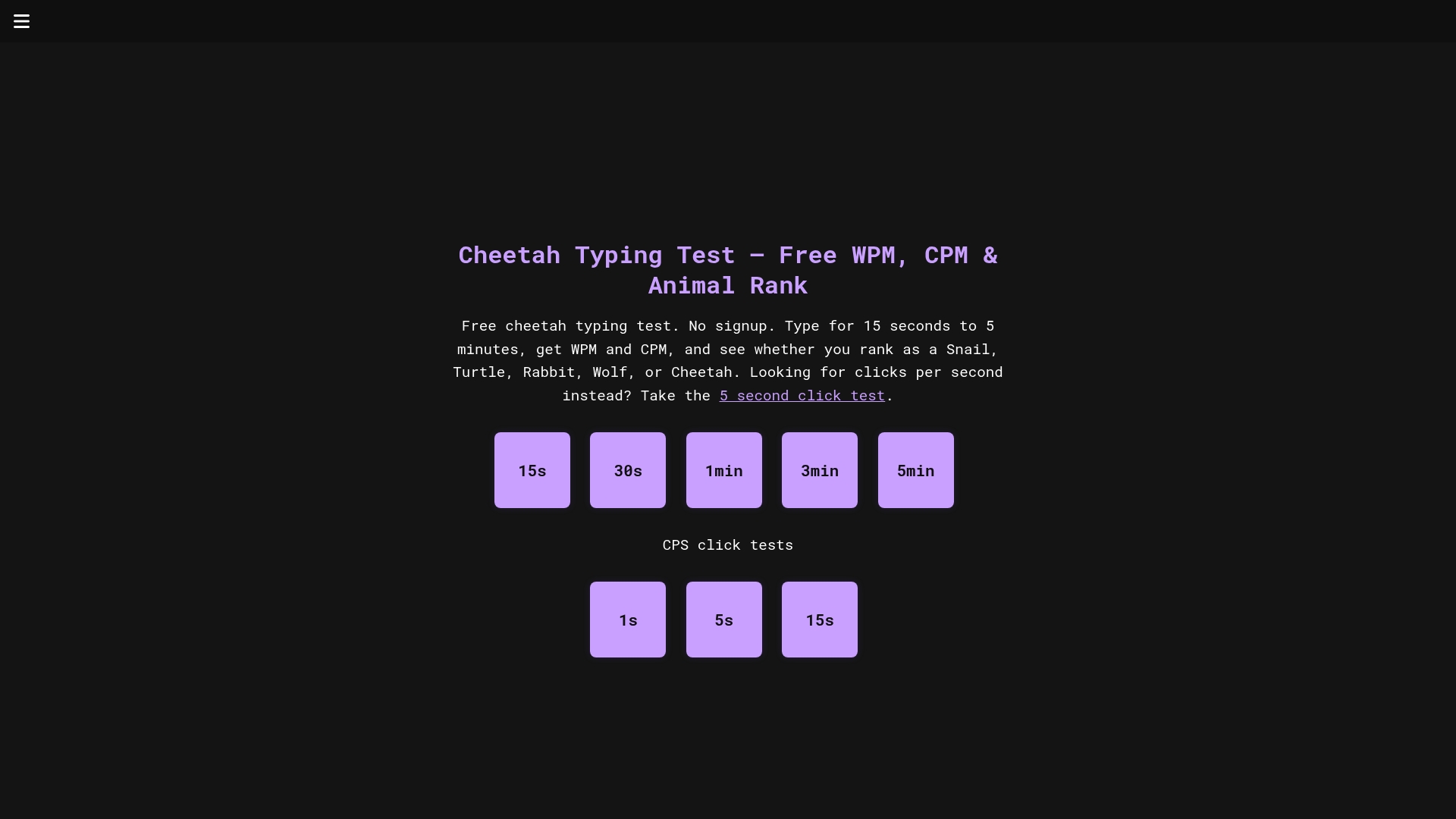
A good first session: one Color Memory round for visual recall, one 30-second click test for speed, and a 3-minute typing test for endurance. Note the three scores and play again tomorrow.
A 20-minute daily routine
Infusion Health proposes a 20-minute routine that is easy to copy:
- 5 minutes of a concentration game. Card matching, a sequence game or a color memory round.
- 10 minutes of a single-task sprint. Pick one task, silence notifications, work on nothing else.
- 5 minutes of an attention task. Timed reading or mental arithmetic works, and so does a timed typing test.
Tips to make it stick:
- Play at the same time each day. It turns the routine into a habit.
- Raise the difficulty only when you are winning easily. Add pairs, add items to the sequence, move up from one-back to two-back.
- Keep a simple log. Write down scores, not impressions. An accuracy number or a turn count tells you more than a feeling.
- Rotate games. The Oregon handout suggests changing games weekly because they may become less engaging over many months.
- Stop when your attention drops. Fatigue is the reason for the 10 to 15 minute cap on digital training.
For a deeper habit plan, see our guide on how to increase your attention span, and for switching between tasks, the one on improving cognitive flexibility.
What research says about brain games
The evidence is encouraging and still developing. A 2025 meta-analysis of 16 randomized controlled trials in healthy people found statistically significant improvements in overall cognitive functioning, processing speed and working memory from brain training games. The authors note that differences in participants, starting abilities and training protocols, and mostly short follow-up periods, make it hard to say how long the benefits last. They also found that aerobic exercise outperformed brain training alone in some studies, so pairing play with a walk or a workout is a good idea.
Other findings worth knowing:
- A 2013 randomized trial of 681 adults aged 50 and over found that 10 hours of visual speed-of-processing training produced small-to-medium gains on a related test.
- A 2015 review describes attention as gating learning, and cites work finding that games focused on attention and object tracking improved working memory.
- Variety seems to matter. A 20-hour multiple-game study found that match-3, spatial-memory and hidden-object games improved different abilities, with spatial-memory and hidden-object games also improving spatial working memory.
The practical takeaway: play regularly, use a mix of games, and treat your scores as feedback rather than a verdict.
FAQ
What is the best game to improve concentration?
There is no single best game, because concentration has several parts. Card matching and sequence games exercise working memory, Stroop tasks and I Spy train filtering, and timed typing or Sudoku train sustained attention. A mix of two or three, played for a few minutes daily, covers the most ground.
How do you play the game Concentration?
Lay a deck of cards face down in a grid and take turns flipping two cards. If they match, you keep them and the game continues. If not, you turn them back over in the same spot, and the player with the most pairs wins. You can also play alone and count how many turns it takes to clear the board.
How long should I play each day?
Short sessions are enough. Guidance from Infusion Health caps digital training at 10 to 15 minutes a day, and a 20-minute routine that includes a single-task sprint is a good target. Students working through a school year can follow the 5 to 10 minute pattern from the Oregon handout.
Can a typing test count as a concentration game?
Yes. A timed typing test asks you to keep your attention on the text, hold upcoming words in mind and keep errors low, all against a clock. Our tests run from 15 seconds to 5 minutes, so you can start short and build up to an endurance run.
Sources
- Concentration Games, Tasks, and Habits That Boost Focus (Infusion Health)
- Actionable Exercises to Boost Focus and Attention Daily (Infusion Health)
- Enhancing and Practicing Executive Function Skills (Harvard Center on the Developing Child)
- How to play Concentration and game rules
- How to play Memory, official rules (UltraBoardGames)
- Working Memory Games (University of Oregon handout)
- Brain Games pack (UC Berkeley)
- Efficacy of Brain Training Games on Cognitive Function, 2025 meta-analysis (PMC)
- A Randomized Controlled Trial of Cognitive Training (PLOS ONE, 2013)
- How to build better memory training games (PMC, 2015)
- Enhancing Cognition with Video Games: A Multiple Game Training Study (PMC, 2013)