Pattern Recognition Games: What to Play and Why
By A. Pepper, CEO of Type Click Tests ·
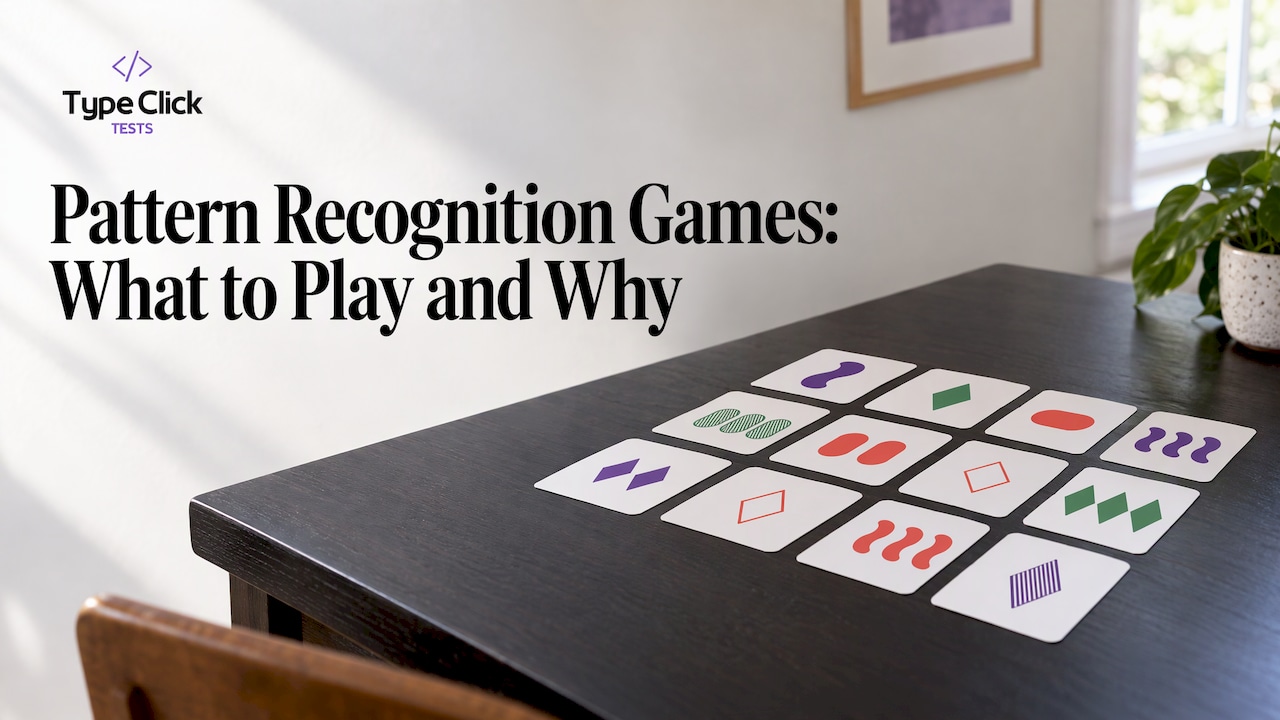
The best pattern recognition games make you find the rule behind a set of items, then use it again and again under mild time pressure. Card games like SET, falling-block and grid puzzles like Tetris and Minesweeper, and short browser games that reward fast, accurate answers all do this. You can try several of the browser versions in a minute or two on Type Click Tests, with no signup, and see your accuracy straight away.
This guide is for students, professionals, gamers and hobbyists who want a game that trains the eye and the hands, not a children’s worksheet. You will get a plain definition, the games worth your time, and a practice routine that makes the skill stick.
TL;DR
- Pattern recognition in games means spotting the rule linking shapes, colors, numbers or positions, then acting on it quickly.
- Card and board games such as SET, Qwirkle and Q-bitz train visual matching. Puzzle video games such as Tetris and Minesweeper train it under time pressure.
- Practice works best when you start with simple patterns, move to harder ones, and check the same types of change in the same order each time.
- Short browser games for memory, reaction and comparison give fast feedback on accuracy and speed, and typing tests do the same for finger patterns.
Table of Contents
- What pattern recognition means in a game
- Card and board games that train visual patterns
- Puzzle video games that train pattern speed
- Quick browser games you can play right now
- Typing is a pattern game too
- How to practice so the skill carries over
- What the evidence does and does not tell you
- Which games suit which reader
- FAQ
- Sources
What pattern recognition means in a game
Learning designer Karl Kapp describes pattern recognition as seeing order in chaos, or seeing relationships in information that looks disconnected. The information can be words, symbols, numbers or images. His examples are familiar: lining up three X’s or O’s in tic-tac-toe while watching what your opponent is building, matching candies in Candy Crush, and fitting falling shapes into solid lines in Tetris.
Researchers who study board games describe a two-stage process. In a DiGRA conference paper, recognition starts with feature detection: your brain groups small visual fragments into larger forms by comparing them against mental templates. Then you build a model of the context and project the next moves. Symmetry and closure, two principles from Gestalt psychology, sit at the core of puzzle design.
In practice, that means every pattern game asks a version of the same question: what is changing, and what is staying the same?
The kinds of change you look for
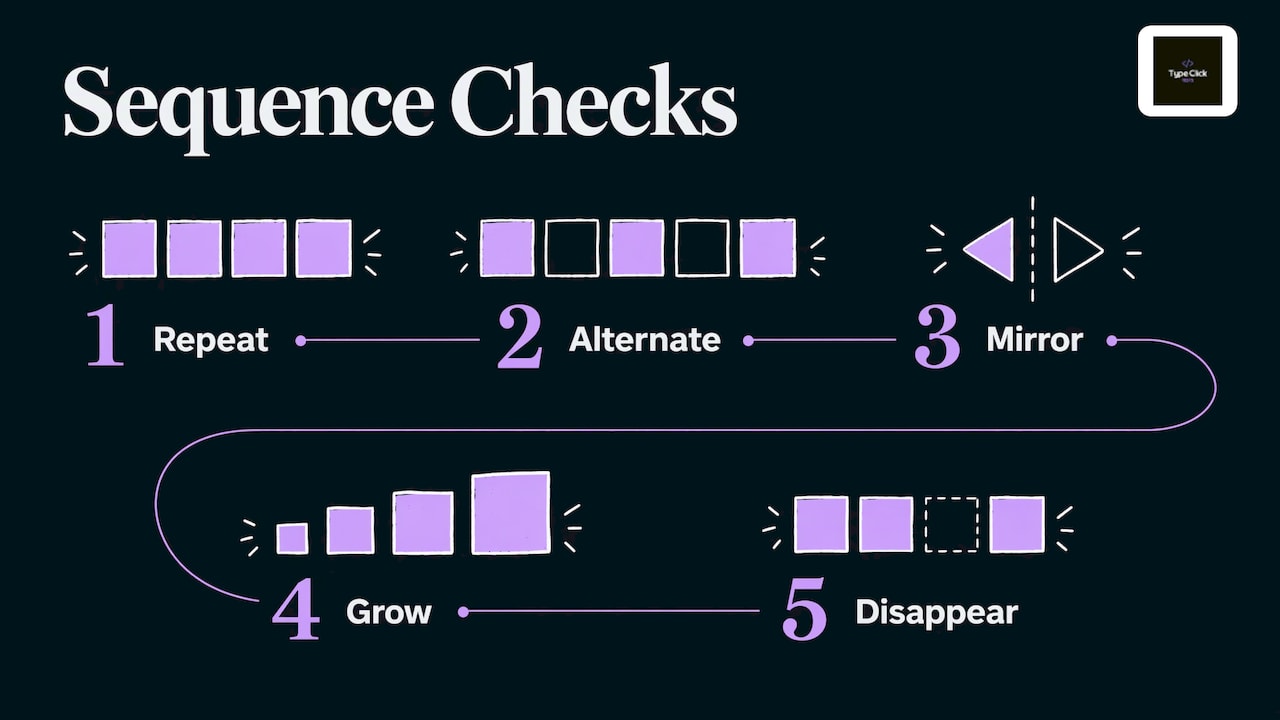
A guide to sequence puzzles lists the items that can carry a rule: numbers, shapes, colors, positions, rotations, sizes, letters or mixed symbols. It says solvers do better by checking the right kinds of change in a careful order (repeat, alternate, mirror, grow, disappear) than by staring harder. That habit works for almost every game in this article.
Card and board games that train visual patterns
Tabletop games are the cleanest way to practice, because nothing moves until you decide. They are also easy to play with a friend or roommate.
SET
SET is the standard answer for adults who want a pure pattern game. According to HowStuffWorks, each card varies in four features: symbol (oval, squiggle or diamond), color (red, green or purple), shade (striped, solid or outlined) and number (one, two or three). A valid SET is three cards that are all the same or all different on every feature. If two match and one does not on any feature, it is not a SET.
The game deals a 12-card spread, adds cards up to 21 if no SET exists, removes found sets and replaces them, and runs through the 81-card deck. You score a point per SET and can lose one for a wrong call. MIND Education recommends it from age 6, lists it as a 5 to 10 minute game for pattern recognition, spatial reasoning and logic, and says it can be played with one person, though two to six is the recommended range.
The skill SET builds is the one that matters most: checking four attributes at once instead of fixating on one.
Qwirkle
Qwirkle has you place tiles that share a color or shape in a line. MIND Education lists it for ages 5 and up, two to four players, about 15 minutes, and links it to shape identification, counting and addition. It is slower and more social than SET, which makes it good for a mixed group.
Q-bitz and Swish
Q-bitz gives you 16 patterned cubes to turn, flip and arrange until they match a challenge card. Math Engaged says it develops visual decomposition, the skill of breaking a design into parts, and recognition of symmetries. The same page describes Swish, where you rotate and flip cards to line colored balls up with matching hoops, and you cannot touch the cards until you have mentally found a match. A US school district’s elementary math games list also includes Q-bitz, listing it for ages 6 and up for spatial and logical reasoning and visual perception.
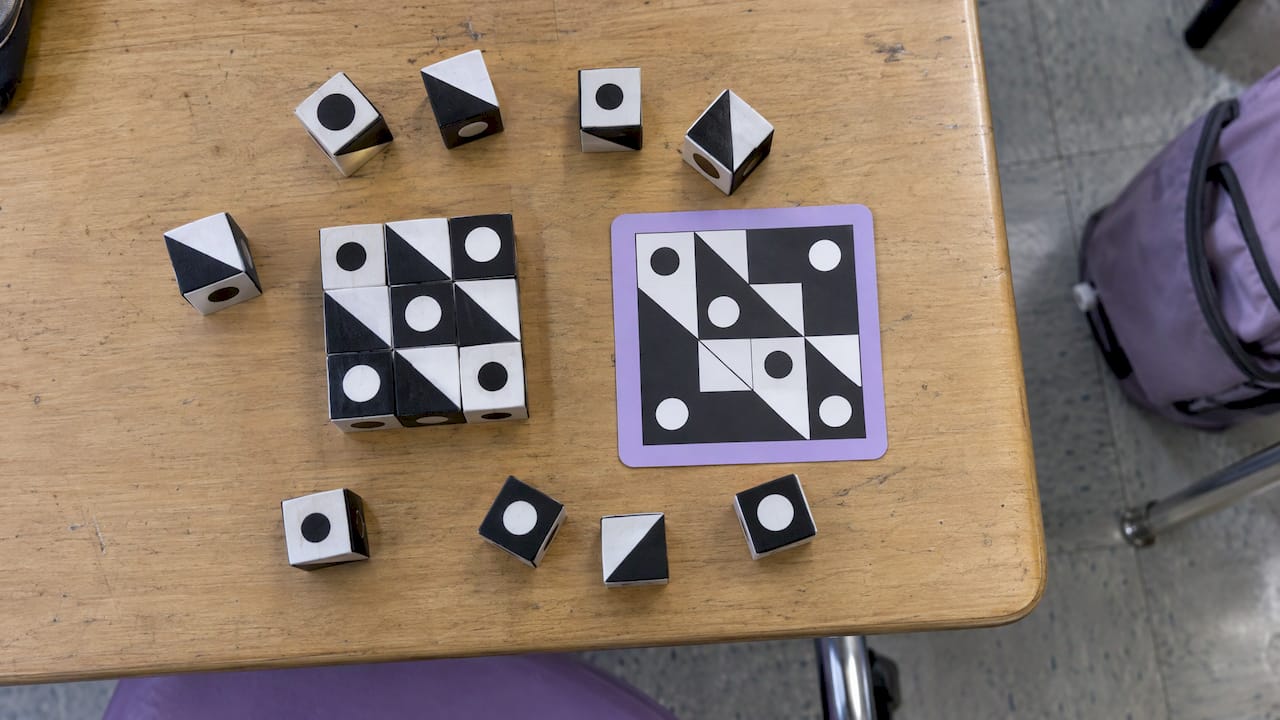
These are labeled for kids, but adults find the timed rounds surprisingly hard.
Six Making
Six Making is for players who want a strategy game rather than a matching game. On a 5×5 grid, each player has 15 disks. On your turn you place a disk or move one or more disks from one tower onto another. Per a review of the game, towers move like chess pieces by height: a tower of two moves like a rook, a tower of four like a bishop. The first player to build a tower of six or more disks with their color on top wins. You are recognizing movement patterns that change every time the board changes.
Puzzle video games that train pattern speed
Video games add a clock or an escalating board, which forces you to recognize patterns without stopping to reason them out.
Tetris and block-fitting games
Tetris asks you to arrange falling pieces into complete lines. A Discover Magazine feature reports that researchers including James Gee recognize cognitive benefits in video games, including pattern recognition, systems thinking and patience. It also describes PET-scan studies by UC Irvine psychologist Richard Haier, in which novice Tetris players’ brain glucose use dropped after a month of regular play while their performance rose sevenfold. The researchers read that as the brain learning to handle the blocks more efficiently.
That result fits what players feel: early on you think about every piece, and later your hands know where it goes.
Minesweeper
Minesweeper looks like a logic game, and at first it is. A review on JayIsGames notes that the classic game eventually became a game of pattern recognition as players learned to read number configurations as mine locations. A strategy guide gives a concrete case: a 1 sitting in a corner square points to a mine in a known spot, so working from corners lets you solve fixed number layouts without re-deriving them every time.
Speed players describe the same shift. Minesweeper Blast says top players do not calculate, they see patterns, and that a 1-2-1 along a wall registers as quickly as reading a word. Its claim is that the gap between a 60-second and a 30-second Expert player is recognizing patterns without conscious thought, plus efficient clicking and minimal mouse travel.
2048 and match-three games
In 2048, you slide numbered tiles to merge them toward a single high tile. In match-three games you line up candies or gems. Both reward the same habit: scanning the whole board for the move that sets up the next move. If you like a number game that involves spotting patterns, 2048 is the obvious pick, since every merge follows a doubling rule you absorb within a few rounds.
Quick browser games you can play right now
Board games need a partner and a box. Browser games need a tab. Type Click Tests offers a set of short games that each train a different part of the same skill: noticing, remembering and responding accurately. They are free and need no account.
Here is how each one fits the pattern recognition habit:
- Color Memory. You guess a color and score your accuracy, which trains visual memory and attention to small differences. Try Color Memory, then read how the five-second guess works.
- Stop the Wheel. A timing game with 30 levels where a miss sends you back to the start. It trains you to read a rhythm and act on it. The Stop the Wheel game and its level-by-level guide are both available.
- Higher or Lower. You compare two items and call which is higher. Building a streak means learning the patterns in what you know. There is a guide to building a streak, and a sugar quiz comparing US and EU foods if you prefer food over geography. There are also height quizzes for NBA and WNBA players, singers and actors.
- F1 Reaction Test. A lights-out start that measures how fast you click. It is a clean test of your response to a single signal: try the reaction test.
You will find all of them from the Type Click Tests home page.
Typing is a pattern game too
Typing is easy to overlook as a pattern skill. Fast typists stop reading single letters and start seeing whole words and familiar letter combinations, then their fingers run learned sequences. That is the same shift Minesweeper players describe when a number layout stops needing calculation.
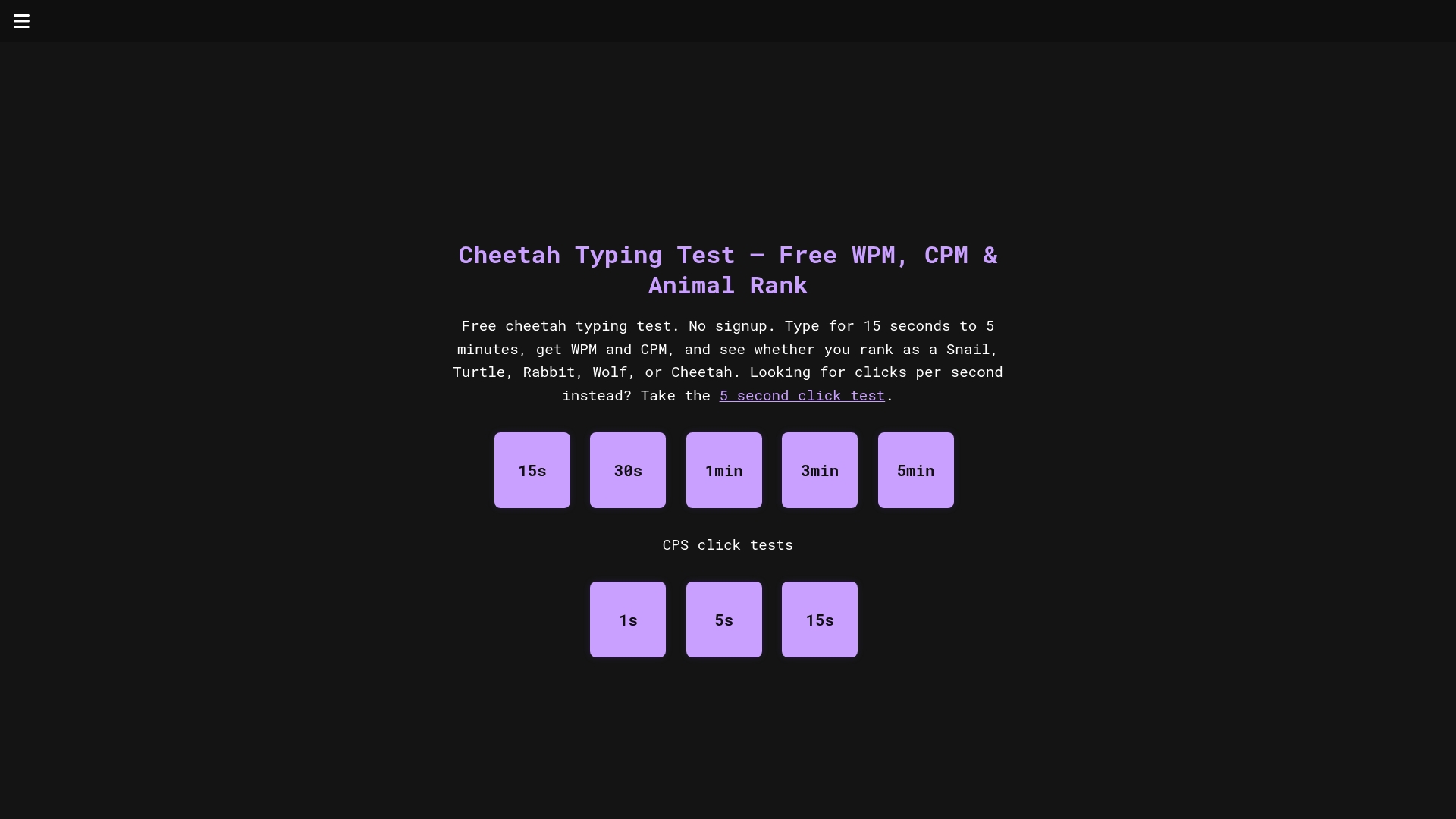
The typing tests at Type Click Tests measure it directly. They run from 15 seconds to 5 minutes and report words per minute, characters per minute and accuracy, calculated instantly in your browser. Your result lands on an animal ranking from Snail up to the top of the scale, with no signup. The clock and ranking criteria stay visible and explained, and accuracy counts as much as speed in the feedback and tips, because speed built on sloppy patterns collapses the moment text gets harder.
Good places to start are the 30 second typing test for a quick check and the 3 minute typing test for an endurance read. If you are a gamer working on mouse speed, the 5 second click test and 30 second click test give you a clicks-per-second score. The full range is on the about page.
How to practice so the skill carries over
Playing a lot is not the same as improving. Use a routine.
1. Start simple, then raise the difficulty
Karl Kapp advises that pattern games start with simple, tangible patterns and move toward complex, abstract ones, give repeated chances to see the same pattern, and keep patterns basic for newer players and more obscure for experienced ones. For you, that means finishing the easy level of a game until it feels automatic before moving up. Do not jump to Expert Minesweeper on day one.
2. Check changes in the same order
Use the list from the sequence-puzzle guide: does the item repeat, alternate, mirror, grow or disappear? Asking in a fixed order beats scanning randomly. In SET, run the same four-attribute check every time: symbol, color, shade, number.
3. Keep sessions short and frequent
Ten focused minutes, several days a week, will teach you more than one long evening. Short tests also make progress visible: take the same 30 second test at the start and end of the week and compare accuracy, not just speed.
4. Track accuracy first
Speed without accuracy trains the wrong pattern. In a typing test, a high speed with many errors means your fingers are repeating mistakes. Slow down until accuracy is high, then push speed.
5. Mix game types
A visual game, a memory game and a reaction game each stretch a different part of the skill. A weekly rotation of one card or board game, one puzzle video game and a couple of browser tests keeps it varied.
What the evidence does and does not tell you
The research here is mostly descriptive. Researchers and designers agree that these games exercise pattern recognition, and the Tetris scans show the brain handling familiar block patterns more efficiently with practice. The practical takeaway is modest and useful: you get faster and more accurate at the specific patterns you train, and the habit of scanning for the rule is something you can bring to other tasks, such as reading data, proofreading or learning an instrument. Treat games as practice for attention, not a promise of any particular result.
Which games suit which reader
| If you are… | Start with | Why |
|---|---|---|
| A student short on time | 30 second typing test, Color Memory | Short, free, instant feedback on speed and accuracy |
| A professional preparing for a typing assessment | 3 minute typing test | Shows how your accuracy holds over a longer stretch |
| A gamer focused on clicking | 5 and 30 second click tests, F1 Reaction Test | Clicks per second and reaction time in the browser |
| A hobbyist who likes puzzles | SET, Qwirkle, Minesweeper | Rule-finding with real depth |
| Playing with family | Qwirkle, Q-bitz | Social, with shapes and colors everyone can read |
FAQ
What are some examples of pattern recognition in games?
Matching three symbols in tic-tac-toe, lining up candies in a match-three game, fitting falling shapes into lines in Tetris and reading number clues in Minesweeper are all examples. Each asks you to spot a repeated structure and act on it.
Which game is best for the brain?
No single game wins, because each trains something different. SET is a strong pick for visual rule-finding, Tetris for spatial fitting under time pressure, and short browser games for memory, reaction and accuracy. Rotating a few works better than picking one.
What is a fun number game that involves spotting patterns?
2048 is a popular choice, because every merge follows a doubling rule you pick up as you play. Number-sequence puzzles, where you find the rule between terms, are another option. A comparison game like Higher or Lower: Countries rewards the numbers you learn along the way.
How long should I practice each day?
Ten to fifteen focused minutes is enough to start. Repeat the same short test, such as a 30 second typing test, and compare your accuracy over the week rather than chasing one fast score.
Sources
- Game Element: Pattern Recognition, Karl Kapp
- DiGRA conference paper on pattern recognition in board games
- Pattern Recognition Puzzles: How to Spot Rules in Sequences and Shapes
- How SET Works, HowStuffWorks
- The Big List of Board Games that Inspire Mathematical Thinking, MIND Education
- Spatial Reasoning and Perception Activities, Math Engaged
- Math Games, Pocatello-Chubbuck School District 25
- Capture the Tower: A Review of Six Making
- This Is Your Brain on Video Games, Discover Magazine
- Mamono Sweeper review, JayIsGames
- Minesweeper World Records by Difficulty, Minesweeper Blast
- Minesweeper Times and Terminology