How to Improve Cognitive Flexibility: Exercises and Games
By A. Pepper, CEO of Type Click Tests ·
You improve cognitive flexibility the way you improve any skill: by repeatedly practicing the thing itself, at a difficulty that keeps rising, and by mixing in genuinely new challenges. Games that force you to switch rules, update a judgment or react to a changing signal are a fast, low-pressure way to do that, and you can start with free browser games on Type Click Tests in the next five minutes.
This guide is for students, professionals, gamers and hobbyists who want a practical routine, not a neuroscience lecture. You will get a plain definition, what the research says about training, a weekly plan, and a list of game types that fit.
TL;DR
- Cognitive flexibility is the ability to adjust your thinking and behavior when the rules or the situation change.
- Research reviews say executive functions can be improved at any age with practice, but gains fade once practice stops, so consistency matters more than intensity.
- Progressive difficulty and real novelty beat repeating the same easy puzzle.
- Rule-switching games, reaction games and quick-judgment quizzes give you short daily reps; pair them with new skills like a language or an instrument.
- Sudden or severe changes in how you think or adapt are a reason to talk to a doctor, not to train harder.
Table of Contents
- What cognitive flexibility actually is
- Can you improve it with practice?
- Build the routine: a simple weekly plan
- Games that exercise cognitive flexibility
- Everyday exercises that need no screen
- Making the practice stick
- Try it on Type Click Tests
- When difficulty adapting is more than a skills gap
- FAQ
- Sources
What cognitive flexibility actually is
Cognitive flexibility is the skill of changing course mentally. Researchers describe it as adjusting behavior appropriately to a changing environment: you disengage from what you were doing, set up a new response, and carry it out. The same review links it with better reading in childhood, resilience to stress and creativity in adults, and better quality of life in older age.
In everyday terms, it is what you use when:
- You are typing a report and a coworker asks a question, and you have to drop one task and pick up another without losing your place.
- A game patch changes the meta and the strategy that won yesterday now loses.
- A study method stops working before an exam and you have to try a different one.
- You catch yourself stuck on one solution and make yourself look for a second.
A review of the field breaks it into several parts: shifting attention, updating strategies, responding to feedback, reversing a learned rule, exploring options and switching between tasks. That matters for training, because each part can be practiced with a different kind of exercise.
Can you improve it with practice?
Yes. A widely cited 2015 review by Diamond and Ling concluded that executive functions can be improved at any age through training and practice. Cognitive flexibility is one of the three core executive functions, alongside working memory and inhibition (holding back an automatic response).
The same review gives you three design rules worth using:
- More weeks help. Across the computerized programs studied, which ran from 2 to 14 weeks, longer training produced better outcomes when session length and frequency were held constant.
- Difficulty has to climb. Gains depend on how much practice you get at progressively harder levels, the deliberate-practice idea applied to the mind.
- Gains fade without upkeep. Like physical fitness, benefits diminish after practice ends, although they can last months or even years.
The practical translation: a short daily routine that you can actually sustain for two to three months beats a heroic weekend of puzzles.
What the training research shows
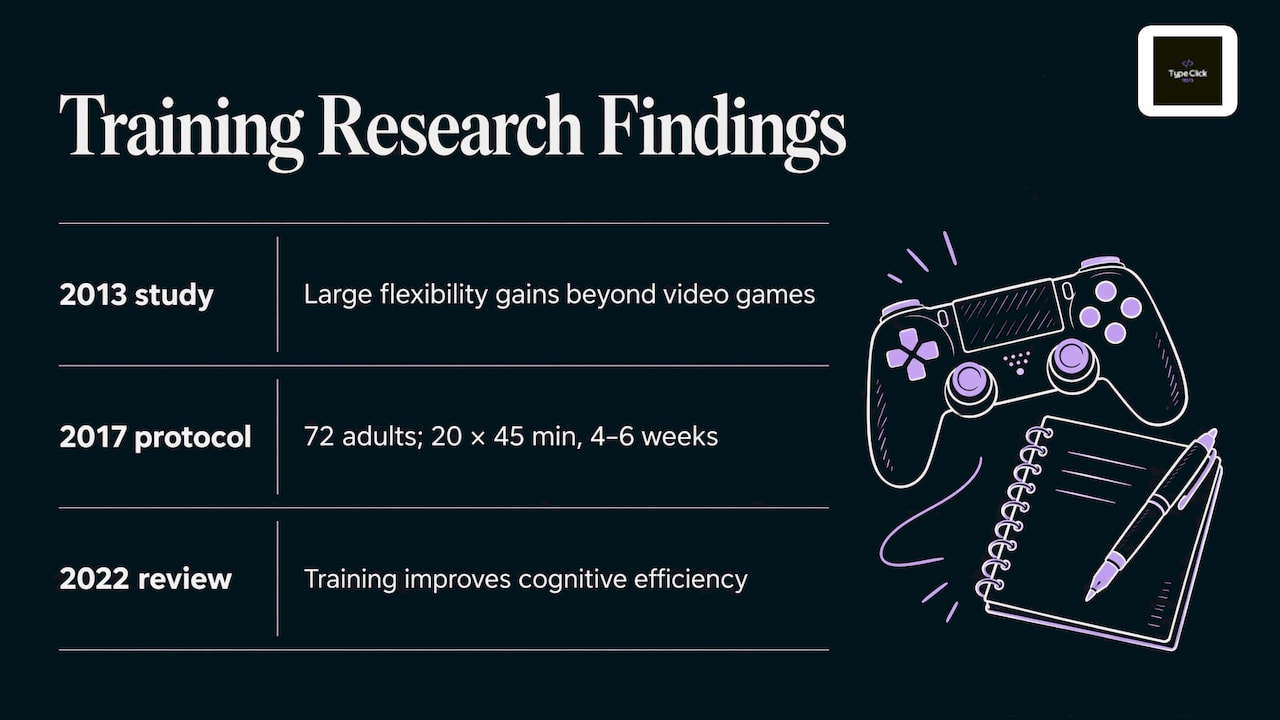
Studies that look at flexibility training directly are encouraging. In a 2013 study, real-time strategy game training that emphasized keeping track of several information sources and switching quickly between them produced a large increase in cognitive flexibility, measured with a wide array of tasks that were not video games.
A 2017 EEG study of 72 healthy young adults tested game-based flexibility and attention training: 20 sessions of 45 minutes over four to six weeks. The trained groups improved their overall reaction times more than a control group playing math games, and the brain recordings showed better response selection and conflict monitoring after flexibility training. The authors suggest an ideal program would combine task switching and attention practice, with as much variety within and between games as possible.
A 2022 review in Nature Reviews Psychology adds a useful way to think about the payoff: there is substantial evidence that training improves cognitive efficiency, meaning you perform better within your existing mental capacity. For most readers, that is exactly the goal. You are not trying to become a different person, you are trying to switch faster, waste less effort and recover sooner after a surprise.
One more principle follows from all of this: the closer your practice is to the skill you want, the better. If you want to switch between tasks faster at work, practice task switching. If you want to react faster to a change in the screen, practice reaction tasks.
Build the routine: a simple weekly plan
Here is a plan that follows the research principles (regular, progressively harder, varied) and fits into about 15 minutes a day.
| Day | Focus | What to do | Time |
|---|---|---|---|
| Mon | Rule switching | A game or puzzle where the rule changes between rounds | 15 min |
| Tue | Quick judgments | Higher-or-lower style quizzes where you update your estimate each round | 15 min |
| Wed | Reaction and timing | A reaction or timing game, aiming to beat your last score | 10 min |
| Thu | New skill | 15 minutes of something unfamiliar: a language app, an instrument, a new keyboard layout | 15 min |
| Fri | Memory and switching | A memory game, then switch to a different task right after | 15 min |
| Sat | Strategy | A strategy game or board game with changing conditions | 30 min |
| Sun | Review | Look at your scores and raise next week’s difficulty | 5 min |
Two habits make this work. First, log your scores. A number you can beat is the simplest form of progressive difficulty. Second, raise the challenge when a task starts to feel automatic, because automatic means it no longer stretches you.
Games that exercise cognitive flexibility
Not every game trains the same thing. Here is how common game types map to the parts of flexibility.
Rule-switching games
These change the rule while you play. Harvard’s Developing Child program recommends card games like Crazy Eights, Uno, Spoons, Blink and SET for practicing cognitive flexibility, and logic puzzles such as Mastermind for working memory and flexibility challenges. They are written for children, but the mechanic (a matching rule that keeps changing) works at any age if you play faster or against better opponents.
Strategy and board games
Brown University Health lists chess, checkers, Sudoku, Clue, Battleship and Connect Four among games that exercise executive functions, and advises moving from beginner to mastery level. Their memory-disorders specialists also make a point that fits the research above: repeating familiar puzzles keeps your brain active, but building real reserve takes advancing in difficulty and learning genuinely new things, such as a language or a new skill.
Quick-judgment quizzes
In a higher-or-lower quiz, you compare two things, commit, see the answer, and immediately reset your mental model for the next pair. That loop of judging, getting feedback and adjusting is the “update your strategy” part of flexibility in miniature. On Type Click Tests you can try Higher or Lower: Countries, City Population Higher or Lower or Protein Higher or Lower. The same site also has calorie, fiber and sugar versions and “Who Is Taller?” rounds with athletes, actors and singers.
Reaction and timing games
These train you to respond to a signal that you cannot predict, then recover when you miss. The F1 Reaction Test asks you to click the moment the lights go out. Stop the Wheel asks for precise timing across 30 levels, and you restart if you miss once, which makes it a good lesson in staying composed and adjusting your timing. If you want the level-by-level details, read the Stop the Wheel guide.
Memory games
Switching is hard when you cannot hold the old rule in mind. A game like Color Memory gives you short memory reps you can chain with a rule-switching session. If memory is your main bottleneck, the guide on improving memory for studying covers methods that work.
Typing and clicking tests as switching practice
Typing tests are not a classic flexibility task, but they are a clean way to practice one thing the research stresses: measurable, progressively harder practice. A 15-second test, then a 3 minute typing test, then a 30 second click test gives you three different demands in a row, and switching between them is itself a mini exercise. Your characters-per-minute and accuracy scores give you the numbers to beat.
Everyday exercises that need no screen
Games are one route. These habits build flexibility in the places you actually use it.
- Change a routine on purpose. Take a different route, use your non-dominant hand for one task, or reorganize your desk. Small disruptions force you to rebuild a habit.
- Argue the other side. Before a decision, write the best case for the option you are leaning against. This trains perspective-taking.
- Learn something genuinely new. Brown University Health’s specialists point to languages and new skills as the way to build lasting reserve, not just repeating what you know.
- Alternate task types. Study for 25 minutes, then switch to a different subject or a practical problem. Make the switch deliberate, not a reaction to distraction.
- Generate three solutions. When you find an answer, force yourself to write two more before you pick one.
- Play with changing rules. Harvard’s list for younger kids includes freeze dance, Simon Says and obstacle courses, because stopping and changing the plan on a signal is the whole point. Adults can use the same idea with a friend or with a game that has timed rule changes.
Making the practice stick
The research suggests a few ways to get more out of the same time.
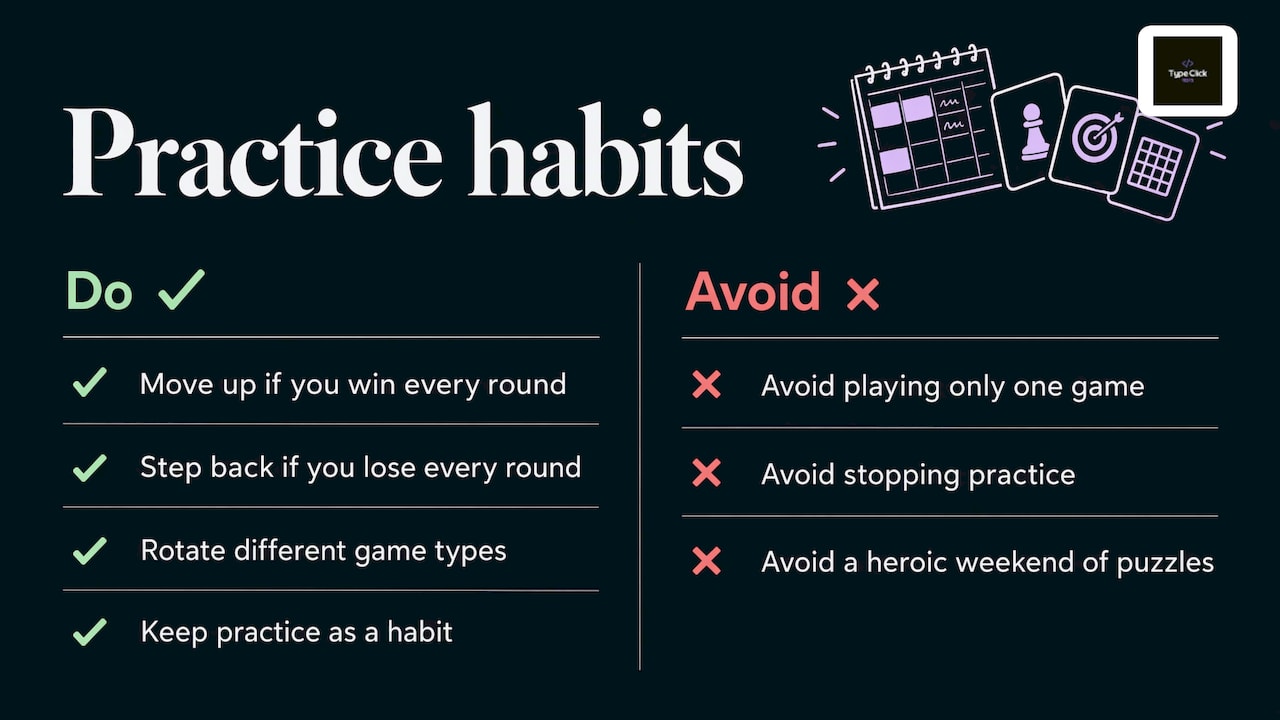
Keep the difficulty just past comfortable. If you win every round, move up. If you lose every round, step back one level. A level you can sometimes beat is where learning happens.
Vary the games. The EEG study’s authors point to maximal task diversity within and between games. Rotating a rule-switching game, a quiz, a reaction test and a memory game covers more of the pieces than playing one game for an hour.
Stay engaged. A review on training for real-world settings argues that adaptive training that uses games to keep people motivated is the most promising route to benefits beyond the practice task. Choose games you actually want to open tomorrow.
Protect the basics. Sleep, exercise and managing stress all affect how quickly you can shift focus. If your attention is what slips first, the guide to increasing your attention span pairs well with this plan.
Keep going. Because gains fade when practice stops, treat this as a maintenance habit, like exercise, not a 30-day challenge.
Try it on Type Click Tests
Every typing test, click test and game on Type Click Tests is free, with no account and no signup, so you can start a rule-switching or reaction session without setup. The site offers timed typing tests from 15 seconds to 5 minutes with instant feedback on speed and accuracy, click speed tests, and browser games covering memory, reaction and comparison challenges. Pick one game from each type in the plan above, write down your first scores, and open the full list of games when you want to rotate.
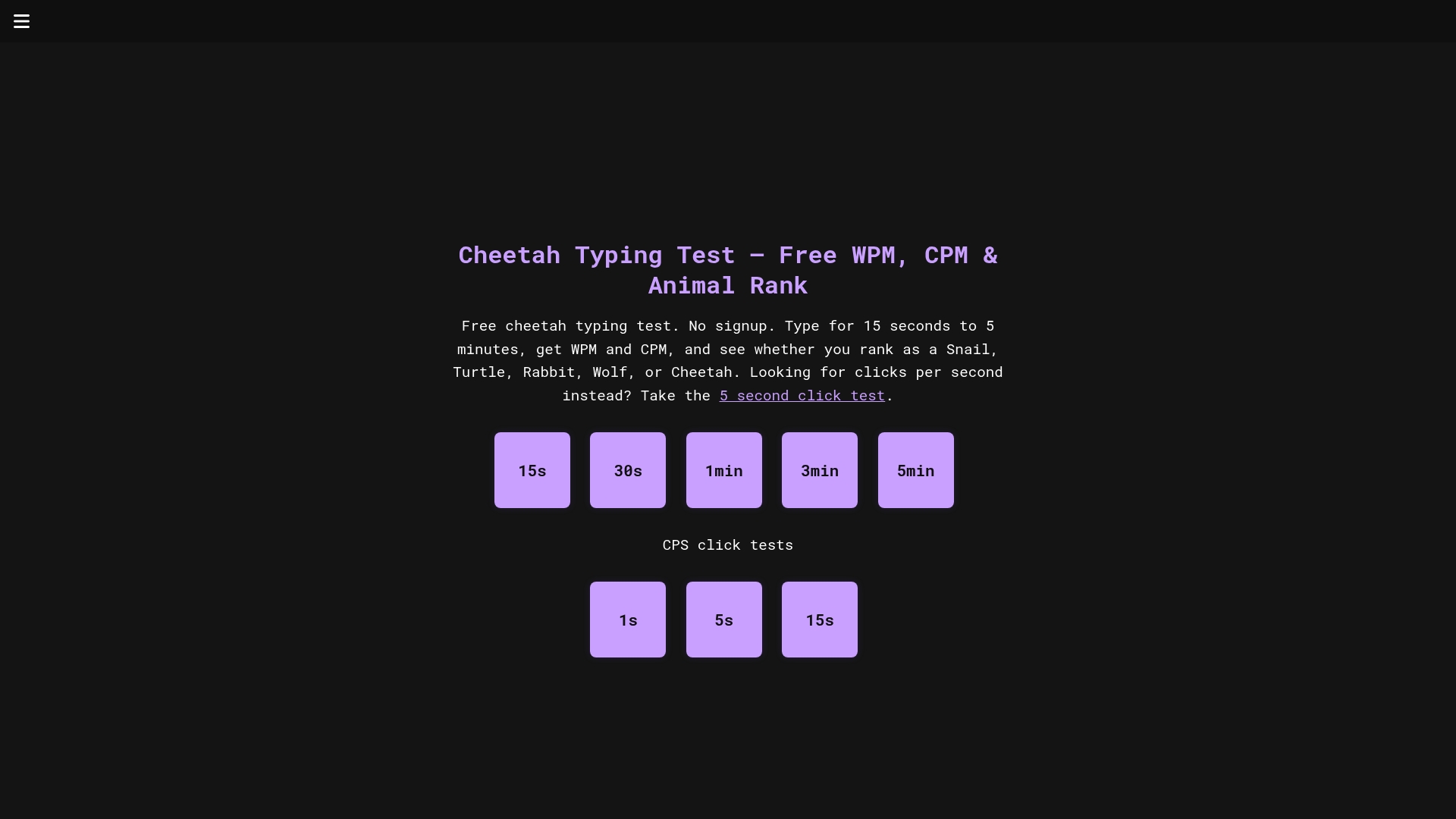
If you prefer to start with the numbers, the typing and click tests give you a baseline for speed and accuracy that you can beat week by week.
When difficulty adapting is more than a skills gap
Everyone gets stuck in a rut sometimes, and chronic stress, fatigue and very routine work can all make thinking feel rigid. Games and habits are a good fit for that.
A sudden change in how you think, plan or adapt, a new confusion after a head injury, or rigidity that disrupts school, work or relationships is a different matter. Talk to your doctor or a licensed psychologist. Conditions such as ADHD and autism are associated with differences in how people shift between tasks and rules, and a clinician can assess that properly and recommend support. Practice games are a complement to that guidance, not a substitute.
FAQ
What are the best exercises to improve cognitive flexibility?
The best exercises ask you to switch rules, tasks or strategies, then get harder over time. Examples include rule-changing card games, strategy games like chess, quick-judgment quizzes, reaction games, and learning a new skill such as a language. Do them regularly for several weeks, since research on computerized training found longer programs produced better outcomes.
Do games really improve cognitive flexibility?
Research shows that game-based training can improve flexibility-related performance. A 2013 study found that strategy game training built on rapid switching produced a large gain on non-game flexibility tasks, and a 2017 study found better reaction times after flexibility training than after a math-game control. Gains are strongest on skills close to what you practice, so choose games that match what you want to improve.
How long does it take to see improvement?
The training studies behind this guide ran from about two weeks to several months, and the 2017 EEG study used 20 sessions over four to six weeks. A routine of 15 minutes a day for six to eight weeks is a realistic starting point. Track your scores weekly so you can see progress.
Do the benefits last?
Benefits can last months or years, but they diminish after practice ends, much like physical fitness. Keeping a lighter weekly routine and continuing to learn new things helps maintain what you built.
Can I improve cognitive flexibility at any age?
Yes. A 2015 review concluded that executive functions can be improved at any age through training and practice. Start at a level that is challenging but doable and raise it as you improve.
Sources
- Demystifying cognitive flexibility (Dajani and Uddin, 2015)
- Conclusions about interventions, programs, and approaches for improving executive functions (Diamond and Ling, 2015)
- Real-Time Strategy Game Training: Emergence of a Cognitive Flexibility Trait (2013)
- Game-based training of flexibility and attention (Olfers and Band, 2017)
- Mechanisms underlying training-induced cognitive change (Nature Reviews Psychology, 2022)
- Cognitive flexibility training for impact in real-world settings (Kourtzi)
- Executive Function Activities for 5- to 7-year-olds (Harvard Center on the Developing Child, 2024)
- Brain Training and Games To Play (Brown University Health, 2022)