How to Improve Memory for Studying: What Works
By A. Pepper, CEO of Type Click Tests ·

The fastest way to remember what you study is to stop rereading and start quizzing yourself, spread over several days. Practice testing and spaced (distributed) practice came out on top in a 2021 meta-analysis of 242 studies, while underlining and summarizing ranked lowest. Below is how to do both, how to remember numbers, and a one-week routine you can start tonight.
TL;DR
- Test yourself instead of rereading: close the book and write or type what you remember, then check it.
- Space it out: review on Day 1, Day 2, then after 3 days, 1 week and 2 weeks.
- Break numbers into meaningful chunks (12-25-1985 instead of eight separate digits).
- Protect sleep, because cutting it short impairs forming new memories.
- Keep sessions short and take real breaks. A quick browser game like Color Memory fits a five-minute pause.
Table of Contents
- Why rereading feels good and works badly
- Self-testing: the single biggest upgrade
- Spacing: when to review
- Flashcards done properly: the Leitner system
- Mix it up: interleaving and explaining
- Do memory palaces work?
- How to remember numbers better
- Sleep, place and breaks
- A one-week routine you can copy
- Try it on our free tools
- FAQ
- Sources
Why rereading feels good and works badly
Most students reread and highlight. A 2013 review by Dunlosky and colleagues found that these habits don’t consistently raise performance, while practice testing and distributed practice earned high utility ratings.
The trap is familiarity. When you reread a page, the words look known, so your brain reports “I’ve got this.” That feeling comes from recognizing the text, not from being able to produce it later on an exam.
Researchers Henry Roediger and Kathleen McDermott call the better methods “desirable difficulties”: spacing, interleaving and retrieval practice feel harder and more error-prone in the moment, but they slow forgetting. Cramming can win on a test taken right away. When the test is delayed, the pattern reverses.
If studying feels a little uncomfortable, that is usually a sign it is working.
Self-testing: the single biggest upgrade
Retrieval practice means pulling information out of your head instead of putting it back in. Flashcards, practice questions, a blank page where you write everything you remember: all count.
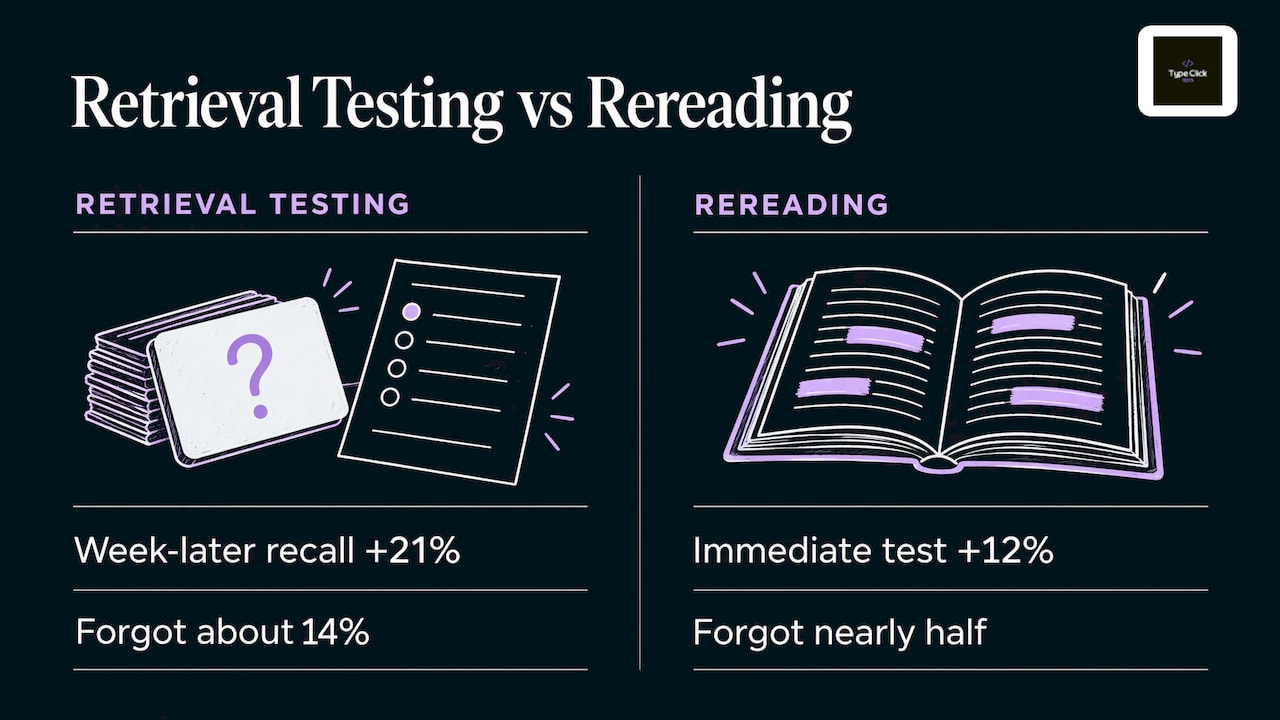
The evidence is striking. In a review by Roediger and McDermott, students who studied a passage once and took three tests recalled 21% more a week later than students who studied it four times. The rereaders did better on an immediate test, by about 12%, but they forgot nearly half of the material, against about 14% for the tested group.
Purdue psychologist Jeffrey Karpicke, quoted by the American Psychological Association, explains that each time a memory is retrieved it becomes easier to retrieve again. Getting a fact right once in a session does not mean it is learned.
Feedback matters
The 2021 meta-analysis found practice testing worked better when students got feedback. Always check your answers against your notes, and mark what you missed. Those misses are your next session.
How to build good questions
- Turn each heading in your notes or textbook into a question.
- Write questions that need an explanation (“why does X happen?”), not only a definition.
- Cover the answer, respond from memory, then check.
- Color-code results: green for right, red for wrong. The Foundations of Learning study-strategies chapter recommends exactly this, so your next review goes straight to the red ones.
Typing works well here. If you take notes on a laptop, close them and type what you remember in a blank document, then compare. A faster, more accurate typist spends less effort on the keyboard and more on recall, which is why many students pair this habit with a few minutes of typing practice. Our guide to typing faster without losing accuracy covers that side.
Spacing: when to review
Spaced practice means splitting your study into sessions separated by time. A 2026 meta-analysis of 13 studies with 21,415 learners in medical education found a significant advantage for spaced repetition over standard studying (standardized mean difference 0.78). The University of California, Berkeley’s student wellbeing guide also cites a 2025 meta-analysis showing that distributed practice improves long-term retention compared with massed study.
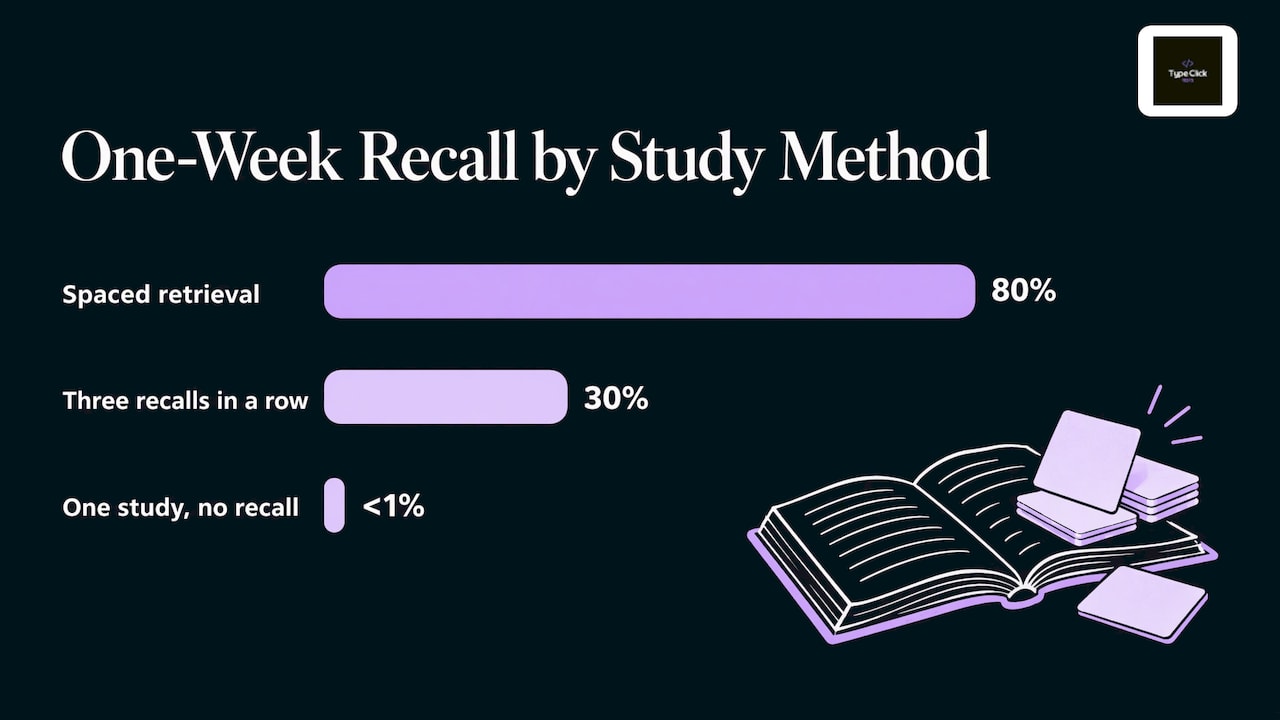
The gap is dramatic in one classic experiment reported by the APA. Students who practiced foreign-language words with repeated, spaced retrieval remembered 80% a week later. Those who recalled the words three times in a row remembered 30%. Those who studied once with no recall remembered less than 1%.
A simple review schedule
The Foundations of Learning chapter suggests this pattern:
| When | What to do |
|---|---|
| Day 1 | Study the material with active recall |
| Day 2 | Write sample test questions |
| Day 4 (after 3 days) | Practice test |
| After 1 week | Practice test |
| After 2 weeks | Practice test |
Working back from an exam date? Place the Day 1 session at least two weeks earlier if you can. If you only have a few days, shorten the gaps but keep them. Two sessions on two different days beat one long session.
The honest problem: cramming
University of New Hampshire researcher Catherine McCabe notes that students intend to space their study more than they actually do, and their real schedules often end in cramming. The fix is to put review sessions in your calendar the day you first study something, not to rely on motivation later.
Flashcards done properly: the Leitner system
Flashcards are retrieval practice in a convenient package, but only if you use them in a spaced way. The University of Rochester’s Learning Center recommends the Leitner system:
- Make three piles: frequent, moderate and review periodically.
- Start every new card in the frequent pile.
- Move a card forward when you answer correctly and back when you miss it.
- Practice the frequent pile about daily, the moderate pile every couple of days, and the mastered pile a week or more apart.
- Retire a card only after several successful retrievals over days or weeks.
A few habits make cards stronger. Put one idea on each card. Say or type the answer before flipping. Shuffle the deck so you don’t learn the order instead of the content.
Mix it up: interleaving and explaining
Barbara Oakley’s 10 Rules of Good Studying adds several habits worth borrowing:
- Recall after each page. Look away and say the main idea before moving on.
- Interleave. Alternate between problem types instead of doing twenty of the same kind in a row.
- Ask why. Use explanatory questions and analogies to connect new ideas to what you know.
- Work in 25-minute timed sessions, then take a break.
The Queensland Brain Institute likewise lists minimizing distractions, spreading out learning, mixing topics and telling stories among its science-based tips. Putting your phone in another room is a free upgrade to any session.
Do memory palaces work?
The loci method, or memory palace, means placing items you want to remember along a familiar route, such as the rooms of your home. A 2021 meta-analysis of 13 randomized controlled trials found a medium effect (g = 0.65), mostly in university settings.
It suits ordered lists: the steps of a process, the cranial nerves, the order of historical events. For ideas and explanations, self-testing and spacing do more of the work. Use the palace to hold the list and retrieval practice to keep it alive.
How to remember numbers better
Numbers have no built-in meaning, so they are hard to hold. The fix is to give them meaning and keep them in small groups.
Chunk the digits
Working memory handles only a handful of items at once. Baylor University’s open Cognition textbook shows how the digits 1 2 2 5 1 9 8 5 become 12-25-1985, a date. Eight items turn into three meaningful units. A chunk can be personal too: the book notes that 41-33 could be a favorite team’s Super Bowl score.
For longer strings, split a 10-digit phone number or a 16-digit card number into three or four smaller groups, as Verywell Health suggests.
Attach meaning
Look for dates, ages, running times, jersey numbers or patterns. The same Verywell Health guide shows 17762010 remembered as 1776 (the Declaration of Independence) plus 2010. It also shows a zip code, 74454, remembered as the rising sequence 7-8-9 because 4+4 is 8 and 5+4 is 9.
A study of one subject in a Carnegie Mellon-hosted paper on expert memory shows how far this can go. After about 865 practice sessions over more than three years, he built meaning-based structures and could recall up to 104 digits presented one per second. You don’t need that, but it shows number memory is a trainable skill.
A quick number routine
- Split the number into groups of three or four.
- Give each group a meaning (a year, an age, a time, a score).
- Say the groups aloud once.
- Cover the number and rebuild it from your meanings.
- Test again after a few hours and then the next day.
That is the same retrieval and spacing logic as everything above, just on a smaller scale. For formulas and dates in a course, put them on flashcards in the Leitner piles.
Sleep, place and breaks
Studying well can be undone by studying tired. The Berkeley guide cites a 2024 meta-analysis finding that restricting sleep impairs the formation of new memories. It also cites a 2025 real-world study in which people remembered information better when they returned to the place where they first learned it. Practically, that means protecting your sleep the night after a big study session, and, when you can, doing a final review in the room where you’ll be tested.
Breaks help sessions stay sharp. After a 25-minute block, stand up, drink water, look out a window. If you like something playful, a short round of Color Memory or a quick reaction test takes only a few minutes. Set a timer so the break stays a break.
A one-week routine you can copy
Here is how the pieces fit for one chapter or topic.
| Day | 25-minute block | Notes |
|---|---|---|
| Monday | Read the chapter, turn headings into questions | Recall after each page |
| Tuesday | Answer your questions from memory, mark green and red | Write sample test questions |
| Thursday | Practice test, focus on red items | Check answers right away |
| Following Monday | Practice test, mixed with another topic | Interleave |
| Two weeks later | Final practice test | Retire cards you’ve answered correctly several times |
Total time is about two hours across two weeks, and you never reread the whole chapter. If you also type your notes or answers, a ten-minute daily typing routine keeps your keyboard skills improving alongside your studying.
Try it on our free tools
We built Type Click Tests so you can practice without signing up. Our typing tests and click tests run from 15 seconds to 5 minutes and give instant feedback on speed and accuracy, which helps if you type your notes and want to spend less effort on the keyboard. For a break between study blocks, the Color Memory game and our other browser games are free to use.
FAQ
What is the best way to remember what you study?
Test yourself on the material instead of rereading it, and repeat the testing over several days. Practice testing and distributed practice were the most effective of ten techniques in a 242-study meta-analysis. Check your answers afterward, because feedback makes testing work better.
How long before an exam should I start studying?
As early as you can, ideally two weeks or more. A schedule of Day 1, Day 2, then reviews after 3 days, 1 week and 2 weeks is a solid template. With less time, keep the sessions on separate days and shorten the gaps.
How can I remember numbers better?
Group digits into chunks of three or four and attach meaning to each, such as a date, an age or a score. Then cover the number and rebuild it from memory, repeating after a few hours and the next day.
Is rereading and highlighting useless?
They are weak as main strategies. A major review found they don’t consistently improve performance. They are fine for a first pass through the material, as long as you follow with self-testing.
Does a memory palace help with studying?
Yes, mostly for ordered lists and sequences. A meta-analysis of 13 randomized trials found a medium positive effect, mainly among university students. Pair it with retrieval practice so the list stays fresh.
Sources
- A Meta-Analysis of Ten Learning Techniques, Frontiers in Education (2021)
- Improving Students’ Learning With Effective Learning Techniques (2013)
- Remembering What We Learn, PMC (2018)
- Six research-tested ways to study better, APA
- The Effectiveness of Spaced Repetition in Medical Education, PubMed (2026)
- Test better: How to remember what you study, UC Berkeley
- Chapter 6: Study Strategies, Foundations of Learning
- Considerations for Academic Support Centers, University of New Hampshire (2023)
- The Ins and Outs of Using Flashcards, University of Rochester
- 10 Rules of Good and Bad Studying, University of Toronto
- Science-based tips to improve learning, Queensland Brain Institute
- The effectiveness of the loci method as a mnemonic device, PubMed (2021)
- Chapter 5. Short-Term and Working Memory, Baylor Cognition
- Elaborative Rehearsal to Improve Your Long-Term Memory, Verywell Health
- Simulation of Expert Memory Using EPAM IV, Carnegie Mellon