How to Increase Your Attention Span: Habits, Exercises and Games
By A. Pepper, CEO of Type Click Tests ·

You can increase your attention span. The reliable route is to remove what pulls your focus away, take planned breaks, move and sleep enough, and then practice holding attention on one task at a time. Short, single-task games are a simple way to do that practice. A 30-second click test, a typing test with a visible clock or a reaction game gives you one clear goal, one score and a few minutes of undivided focus. Below you will find the habits with the best support, a ten-minute routine, and how to use online concentration exercises without turning them into another distraction.
TL;DR
- Attention responds to environment first: put the phone in another room, close extra tabs and do one thing at a time.
- Work in blocks with short breaks, and add regular aerobic exercise, 7 to 9 hours of sleep and a brief daily mindfulness practice.
- Games that ask for sustained, single-task focus make good practice. In one randomized trial, 8 hours of a focus game over 4 weeks improved sustained visual attention.
- Our free typing, click, reaction and memory tests take 5 seconds to 5 minutes, need no signup, and give you a score to track.
- If trouble focusing is frequent or gets in the way of daily life, see a doctor.
Table of Contents
- Why your attention drifts in the first place
- Set up your space before you train your focus
- Build the body habits that support attention
- What the research says about games and attention
- Online concentration exercises you can start today
- Try our tests as part of your routine
- A 10-minute attention routine
- How to track progress without getting stuck on the score
- Match the exercise to your goal
- When a short attention span needs a doctor
- FAQ
- Sources
Why your attention drifts in the first place
Attention is not a muscle that simply switches off when you are weak-willed. Research from the University of Rochester shows the brain scans for new information several times per second, which creates brief windows where a distraction can pull you away. The brain does this on purpose, so you do not over-focus on one thing. The practical lesson from that work is that the best defense is removing potential distractions rather than relying on willpower.
There is also a reward side. Dr. Anna Costakis of Northwell explains that dopamine is less a “pleasure chemical villain” and more part of how the brain learns what is worth paying attention to. If your day is packed with novelty and interruptions, quieter activities such as reading feel flat at first. That flat feeling is not proof your attention is broken. It is a sign your brain has gotten used to a faster pace, and it can be retrained with steadier activities.
Set up your space before you train your focus
Exercises work better when the room is not fighting you. These changes have the strongest backing.
Move the phone out of reach
Northwell’s physicians note that even a quiet phone in the room keeps part of your attention on standby, so for real concentration the phone belongs in another room. University of Rochester Medicine gives the same advice and adds disconnecting from the internet when your task does not need it. Kaiser Permanente also recommends limiting phone notifications if you cannot remove the device entirely.
Do one thing at a time
Multitasking feels productive and mostly fragments your attention. The federal Care Navigator guidance advises avoiding multitasking and using website blockers when you need to concentrate. Harvard Health’s practical version is modest: keep a short, prioritized list, jot down stray ideas to deal with later, reduce clutter, and choose one strategy to try today instead of overhauling your whole routine.
Schedule breaks instead of pushing through
Many people assume that working without stopping helps focus. Dr. Zucker at Kaiser Permanente notes that it can be more effective to take breaks. Work in time blocks with rest periods in between, because attention wanes after a set stretch, as the Care Navigator guidance explains. During breaks, pick something active and screen-free: stretch, make a snack or step outside. Scrolling is not a break for the part of your brain you are trying to rest.
Build the body habits that support attention
Exercise
The Care Navigator guidance recommends 150 minutes of moderate-intensity aerobic exercise per week. It notes that aerobic exercise increases blood flow to the prefrontal cortex, the part of the brain responsible for focus and concentration. Healthline reports evidence that a brisk 30-minute walk four to five times a week improves attention, including in people with ADHD.
Sleep, food and water
The same federal guidance points to 7 to 9 hours of sleep and a Mediterranean-style diet for brain health. Hydration matters too: Healthline cites evidence that going without fluids for just two hours can impair focus. Keep water at your desk before a long session.
Mindfulness and meditation
Meditation has some of the strongest support for improving attention, and Northwell’s physicians say even brief daily practice helps over time. Two findings help you set expectations:
- A 2018 study found that 8 weeks of 13-minute daily guided meditation improved attention, working memory and recognition memory in adults aged 18 to 45 who had not meditated before, while 4 weeks did not. Give any new practice at least two months.
- A 2016 randomized trial of 75 stressed young adults found that 5 weeks of daily mindfulness meditation, heart-rate biofeedback or physical exercise all improved attention control, with no significant differences between them. In other words, you can choose the one you will actually keep doing.
A simple starter is the body scan Kaiser Permanente describes: notice what you are hearing, feeling and tasting, which trains you to stay present in the moment.
What the research says about games and attention
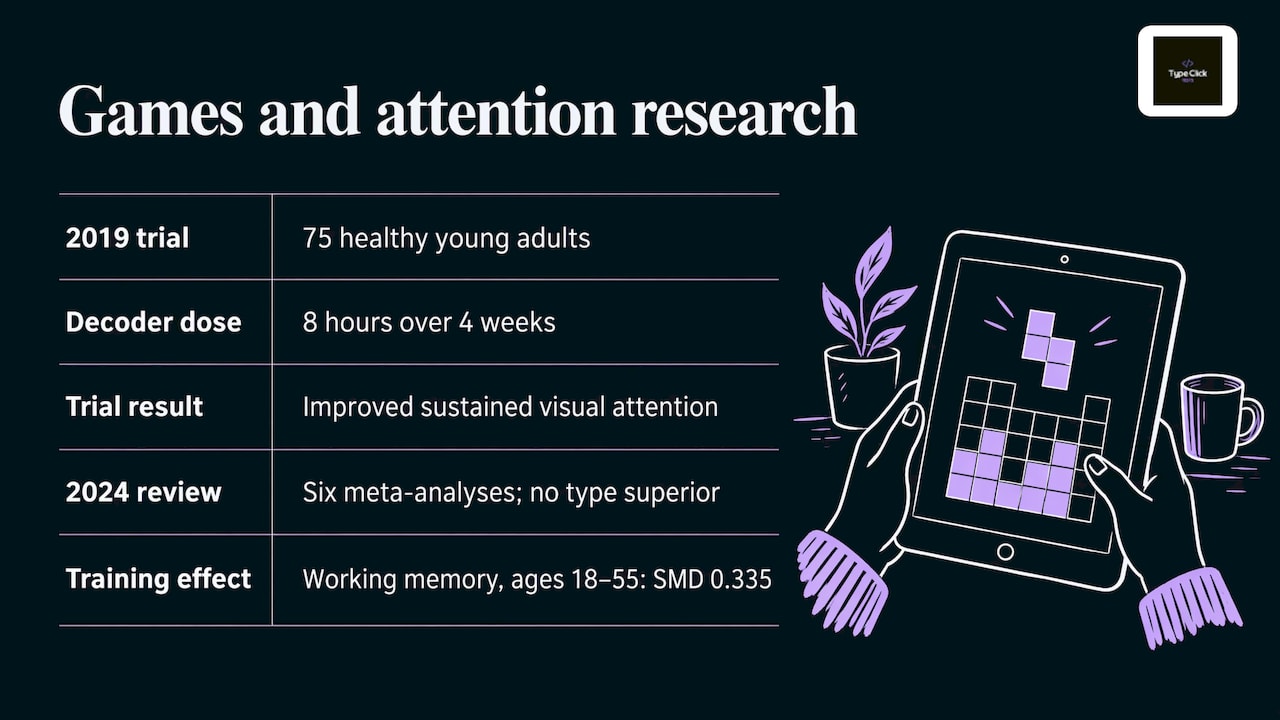
Games are useful for attention when they demand sustained focus on a single goal. The best-known support comes from a 2019 randomized trial with 75 healthy young adults. People who played the iPad game Decoder for 8 hours over 4 weeks showed improved sustained visual attention compared with people who played Bingo or did nothing.
A 2024 second-order meta-analysis of six meta-analyses found that working memory training in healthy adults aged 18 to 55 produced a significant improvement versus controls (standardized mean difference 0.335). The authors found that no single training type, whether mindfulness, adaptive training, physical activity or video games, was proven superior. That is good news for variety: your best option is a mix you enjoy enough to repeat.
Puzzle habits also show up in the data. UCLA Health reports a large study of nearly 20,000 people age 50 and older in which cognitive function was linked to how often they did number puzzles like Sudoku. It also advises varying the types of games you play and limiting screens near bedtime, because blue light can disrupt sleep.
If you have ADHD, treat games as a supplement. Brain training covers a vast range of programs aimed at different skills, and ADDitude’s experts note that the exact program matters, benefits take weeks or months, and you need systematic feedback to judge whether a treatment is working. Medication and behavior therapy are the established treatments, so talk to your doctor about your plan.
Online concentration exercises you can start today
A good focus exercise has four features: one task, a clear clock, an instant score and a short length. That is how we built our free tests, with the clock and ranking criteria always visible and no account to create. Here is how each kind of exercise fits an attention routine.
| Exercise | Time | What it asks of your attention | Where to try it |
|---|---|---|---|
| Click speed test | 5 to 30 seconds | A burst of steady, rhythmic focus on one target | 5 Second Click Test, 30 Second Click Test |
| Typing test | 15 seconds to 5 minutes | Reading ahead while keeping your hands accurate | 3 Minute Typing Test |
| Reaction test | Under a minute | Waiting alertly, then responding at the right moment | F1 Reaction Test |
| Timing game | 1 to 2 minutes | Judging a moving target and committing | Stop the Wheel |
| Memory game | 2 to 3 minutes | Holding information while you decide | Color Memory |
| Higher or lower quizzes | 3 to 5 minutes | Comparing facts and staying engaged over many rounds | Higher or Lower: Countries |
Why a typing test makes a good attention drill
A timed typing test gives you immediate feedback on both speed and accuracy. Our approach gives accuracy equal weight to speed, which is what makes it a focus exercise rather than a race. If your mind wanders for two seconds, you see it in your errors. The 3-minute test is a handy endurance check: the first minute is easy, the third shows whether you can hold steady. Typing also builds a skill you use daily. Our guide on typing faster without losing accuracy covers the technique side.
Why reaction and timing games help
Reaction games train the opposite skill from typing: waiting, staying alert, then acting at the right instant. Stop the Wheel asks you to judge timing and commit to a click, with no room to multitask. Treat them as a warm-up before deep work, or as a quick reset between blocks.
Try our tests as part of your routine
If you want a free, no-signup way to practice sustained focus, start with our typing and click tests. Choose a length from 15 seconds to 5 minutes, get your words per minute, characters per minute and accuracy as soon as the clock stops, and see your animal rank from Snail up. The same typing and click tests sit alongside reaction, memory and comparison games, so you can rotate through different kinds of focus.
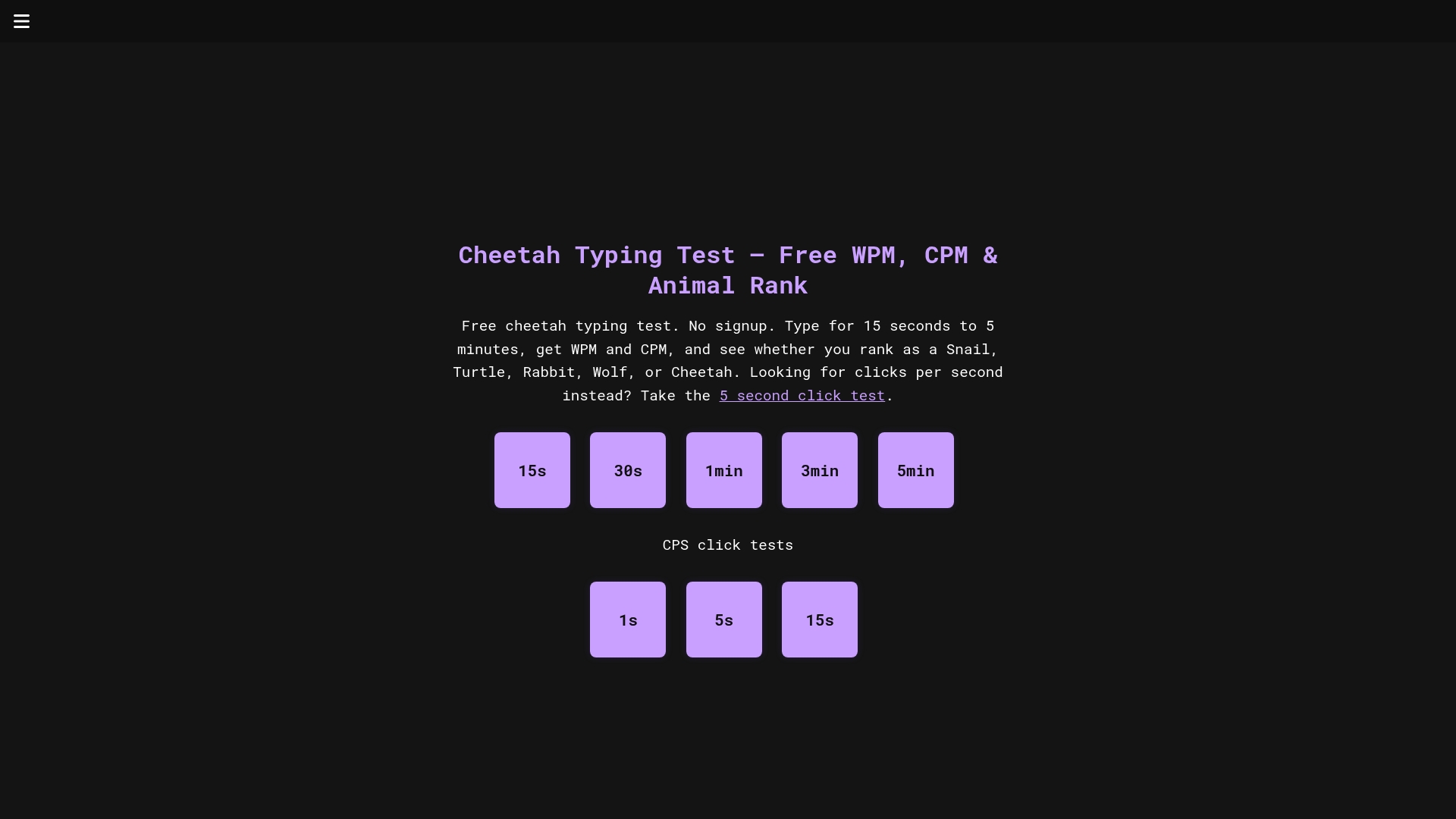
If you prefer variety, our quizzes on calories, protein and fiber give you a steady run of quick decisions, and the full list lives on our home page.
A 10-minute attention routine
The research says to start small and pick one strategy rather than rebuild your life. Here is a routine you can run once a day. Keep it for at least eight weeks, since the meditation study above only saw gains after that long.
- Minutes 0 to 1: set the room. Put your phone in another room, close extra tabs and fill your water glass.
- Minutes 1 to 4: breathe and scan. Do a short body scan. Notice sounds, the feel of your chair and your hands, and the taste in your mouth. When your mind wanders, return without scolding yourself.
- Minutes 4 to 5: warm up with a burst. Take a 5-second or 30-second click test. Your only job is to stay on the target.
- Minutes 5 to 9: one longer task. Take a 3-minute typing test, aiming for accuracy first. Then do one more round if you feel fresh.
- Minute 10: note your results. Write down your accuracy and score. Stop there.
On study or work days, follow this with a time block of focused work on one task, then a screen-free break. If the routine does not suit you, swap in a 30-minute brisk walk. The 2016 trial above found exercise improved attention control about as much as meditation did.
How to track progress without getting stuck on the score
Scores are useful because they make invisible change visible. A few ground rules keep them useful.
- Compare like with like. Use the same test, at roughly the same time of day, a few times a week.
- Watch accuracy before speed. If errors climb as you speed up, your attention is slipping. Slow down until accuracy recovers.
- Expect a plateau. Benefits in the studies took weeks, not days. A week of flat scores says little.
- Stop when you are tired. Scores drop with fatigue, and pushing on turns practice into frustration. Log it and take a break.
- Keep it away from bedtime. UCLA Health advises limiting screen time near bedtime, so do your games earlier in the evening or during the day.
Match the exercise to your goal
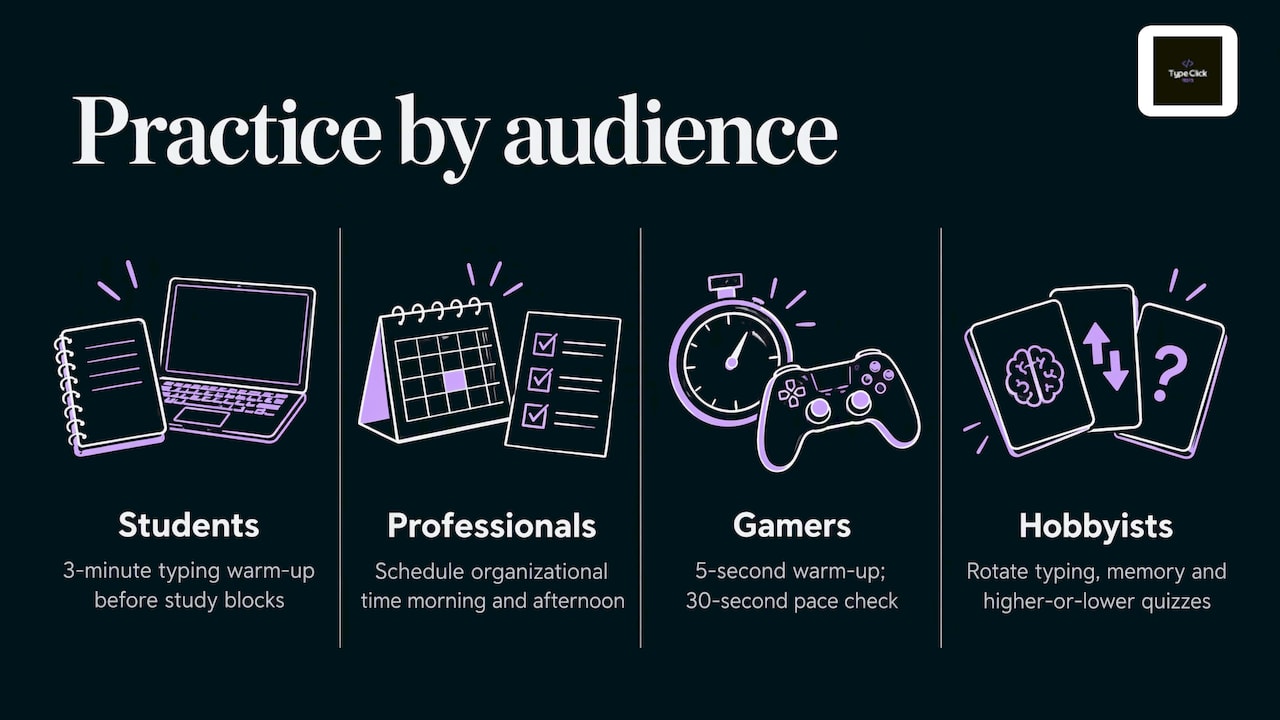
Students. Use a 3-minute typing test as a warm-up before study blocks, then work in a focused block with the phone out of the room. Add a walk during breaks. Handwriting notes can also help: Healthline reports that it is more effective for attention and listening than typing on a laptop, so use it in lectures and your keyboard for drafting.
Professionals. Pair typing tests with the work-day habits above: scheduled organizational time in the morning and afternoon, short prioritized lists and one task at a time. Typing accuracy is also a skill employers check, so the practice does double duty.
Gamers. Click and reaction tests train a steady, repeatable focus. Use the 5-second test to warm up and the 30-second test to check how well you hold pace. Stop the Wheel and the F1 Reaction Test add timing and anticipation.
Hobbyists. Mix it up. Rotate typing, memory and higher-or-lower quizzes so the routine stays fun. The meta-analysis found no training type superior, so enjoyment is a real advantage.
When a short attention span needs a doctor
Habits and games help with ordinary distractibility. A short attention span can also have psychological or physical causes. Healthline lists ADHD, depression, head injury, learning disabilities and autism, and advises seeing a healthcare provider if trouble focusing is frequent or interferes with daily tasks.
Northwell’s physicians say adults should see a primary care doctor or psychiatrist for an ADHD evaluation if, after trying habit changes, they still miss critical deadlines or lose essentials daily, see relationships strained by chronic distractibility, or live in near-constant panic to get things done. Tell the doctor which habits you have already tried. That history makes the evaluation faster and more useful.
FAQ
How long does it take to increase attention span?
Expect weeks, not days. In one study, 8 weeks of 13 minutes of daily guided meditation improved attention, while 4 weeks did not. Another trial found gains after 5 weeks of daily practice. Pick a routine you can keep for at least two months and track your accuracy scores.
Do games to improve concentration actually work?
Some do. A 2019 randomized trial found that 8 hours of the game Decoder over 4 weeks improved sustained visual attention in healthy young adults. Meta-analysis found no single training type superior, so choose games that demand one-task focus and play them regularly.
How do I know if my attention span is low?
Notice whether you can stay with one task for a reasonable stretch without reaching for your phone. A short, accuracy-focused test can give you a baseline to track. If trouble focusing is frequent or interferes with daily tasks, talk to a healthcare provider.
Why is my attention span getting shorter?
A day full of novelty and interruptions can make quieter activities feel flat, and a phone in the room keeps part of your attention on standby. Poor sleep, little exercise and dehydration also play a role. Removing distractions and building steadier habits is the first step.
Sources
- How to Increase Attention Span, University of Rochester Medicine
- How To Improve Your Attention Span, The Well by Northwell
- Trouble focusing? Learn how to increase your attention, Kaiser Permanente
- Improving Concentration and Focus, Care Navigator, LTCFEDS
- Everyday tips for boosted focus, Harvard Health
- Short Attention Span: Signs, Causes and Ways to Pay Attention, Healthline
- Brief, daily meditation enhances attention, memory, mood
- A randomized trial comparing daily mindfulness meditations, biofeedback and exercise, Mindfulness (2016)
- Improvements in Attention Following Cognitive Training With a Game (2019)
- Examining Working Memory Training for Healthy Adults (2024)
- 4 worthwhile brain games for older adults, UCLA Health
- ADHD Brain Training and Memory Games, ADDitude
- How to Treat ADHD in Adults, The Well by Northwell